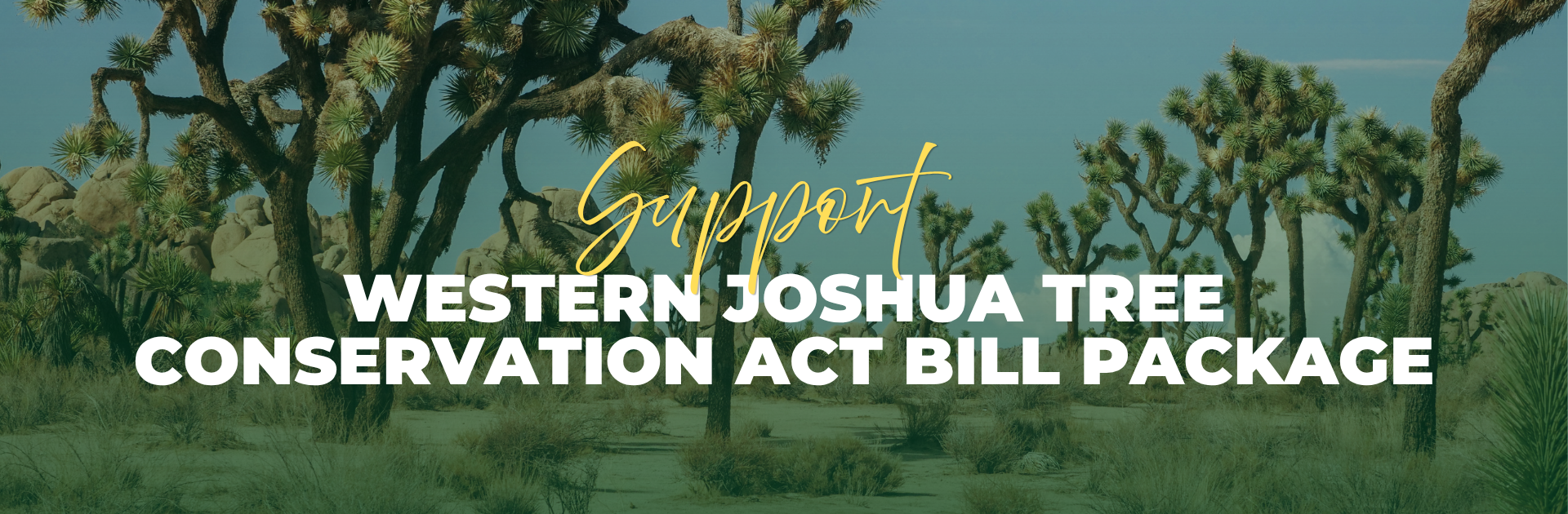
The Western Joshua Tree Conservation Act (WJTCA) bill package is a targeted legislative effort to improve how the law is applied in practice while maintaining protections for the Western Joshua tree.
The package includes three bills:
These measures intended to provide greater clarity, reduce unnecessary regulatory burdens, and support continued access to essential residential and public services in desert communities.
Collectively, these bills respond to concerns raised by property owners, local service providers, and public agencies about how current law affects routine property maintenance, infrastructure improvements, and permitting for life-sustaining services. The package is designed to clarify key legal definitions, align statutory authority with on-the-ground implementation, and establish a more practical, efficient compliance framework under the WJTCA.
Bill Package Details
SB 1061 — Clarification of “Take”
Summary:
Streamlines the relocation permitting process under the Western Joshua Tree Conservation Act (WJTCA) by establishing a clear pathway for residential property owners to relocate up to 10 Western Joshua trees, without payment of fees or other mitigation, when certain conditions are met.
This new process reflects the reality that, in many cases, a take permit issued by the California Department of Fish & Wildlife (CDFW) does not actually authorize the killing of a Western Joshua tree. Instead, relocation is often required as a condition of project approval, and SB 1061 simplifies that process for residents who are trying to preserve a tree by moving it rather than destroying it.
Key Provisions:
- Excludes unintentional or accidental death of a Western Joshua tree from the definition of “take”
- Exempts relocation of trees within or between commonly owned parcels from permitting requirements
Status:
Senate Appropriations Committee
Resources:
SB 1062 — Public Agency Permitting Flexibility
Summary:
Brings balance to the implementation of the Western Joshua Tree Conservation Act (WJTCA) by improving how the California Department of Fish & Wildlife (CDFW) reviews and adjusts mitigation fees over time.
The bills makes clear that, when updating fees, CDFW shall consider making fees proportionate to the impact of a project, and consider using tiered fee structures based on project type, size or other relevant criteria.
Key Provisions:
- Allows:
- Project-wide avoidance and minimization measures
- Reduction or waiver of in-lieu mitigation fees
- Flexible compliance options as determined by CDFW
- Aligns statutory authority with the Western Joshua Tree Conservation Plan (WJTCP)
Goal:
Ensure consistency between law and existing implementation practices.
Status:
Senate Appropriations Committee
Resources:
SB 1063 — Expedited Permitting for Essential Services
Summary:
Ensures that essential, life-sustaining services for residential properties can be installed, maintained, and repaired without facing delays or costly permitting requirements by creating a carve-out for projects subject to the WJTCA.
Specifically, this bill creates an expedited permitting pathway for the taking of a Western Joshua tree, without required fees or mitigation measures, so long as the taking is related to infrastructure that provides electricity, gas, water, sewer, telecom service, or wildfire hardening to a single-family or multi-family residence.
Key Provisions:
- Creates an expedited permitting process for “take”
- Eliminates:
- Permit fees
- Mitigation requirements
Eligibility Criteria:
Applies when impacts are related to infrastructure providing:
- Electricity
- Gas
- Water
- Sewer
- Telecommunications
- Wildfire hardening
For:
- Single-family residences
- Multi-family residences
Status:
Failed passage in Senate Natural Resources and Water Committee
Resources:
What is the Western Joshua Tree Conservation Act
The Western Joshua Tree Conservation Act (WJTCA) is a California Law that was enacted in July 2023. The WJTCA prohibits the importation, export, take, possession, purchase, or sale of any western Joshua tree in California unless authorized by CDFW.
Origin of the Western Joshua Tree Conservation Act and Plan
The formal process to protect the western Joshua tree began on October 15, 2019, when the Center for Biological Diversity (CBD) submitted a petition to the California Fish and Game Commission (Commission) to list the species as threatened under the California Endangered Species Act (CESA). In September 2020, the Commission determined that listing might be warranted and designated the tree as a candidate species, providing temporary legal protection under CESA.
Following this designation, the California Department of Fish and Wildlife (the Department) conducted a status review, which it submitted in March 2022, concluding that listing was not warranted.
In June 2022, the Commission considered the Department’s report (pg. 1-5) but could not reach a decision. To resolve the administrative deadlock and provide a long-term conservation framework, the Western Joshua Tree Conservation Act (WJTCA) was introduced in a budget trailer bill 2023 and signed into law in July 2023.
2022 CDFW Status Review: Recommendation for Petitioned Action
“Based on the criteria described above, the best scientific information available to the Department at this time indicates that western Joshua tree is not in serious danger of becoming extinct throughout all, or a significant portion, of its range due to one or more causes, including loss of habitat, change in habitat, overexploitation, predation, competition, or disease, and is not likely to become an endangered species in the foreseeable future in the absence of special protection and management efforts required by CESA.”